Two in three child casualties in Sudan this year were killed by armed drones, UNICEF said this week — 270 of an estimated 410 children killed or injured between January and September 2026. More than 1,100 people were killed in drone attacks across the country in the first half of the year alone, according to AFP's reporting of the same Geneva briefing. Sudan's drone war is no longer a sideshow to the ground fighting between the Sudanese Armed Forces (SAF) and the paramilitary Rapid Support Forces (RSF), the former allies whose war began in April 2023. It is the mechanism carrying the war into places that were once safe — above all, into the power stations everything else depends on. In the last week of October, UNICEF spokesperson James Elder told reporters, not a single day passed without a drone strike on a power station in Sudan. What follows is Sudan's drone war explained from that briefing and AFP's reporting of it: what the UN has documented, and what it has deliberately not claimed.
How did Sudan's drones change?
From one-way terror weapons to long-range precision, in about a year. "Several years ago, there was a use of suicide drones, which was terrifying to see that in Sudan," Elder explained. Over the last twelve months, he said, the drones in use have become increasingly accurate and their range has grown — some travel 1,500 kilometres before hitting their target. Range is the strategic fact: at 1,500 kilometres, distance stops protecting anywhere in a country of Sudan's size, which is why Elder says the weapons are "bringing war to places that were once safe." He gave the human version from El Obeid, where UN Human Rights Council investigators say civilians live in constant fear of drone attack: a teenager called Buri, who lost both hands to an explosive, learns online in the mornings from his tent and spends the afternoons picking grass for animals. "People in Sudan talk about three things: they talk about safety, education and water," Elder said. "Drones are taking all three."
Why do power stations matter so much when they are hit?
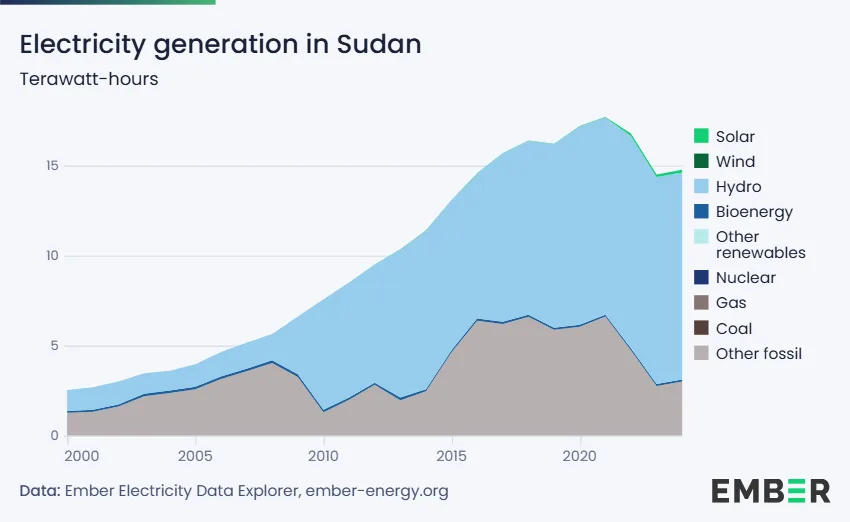
Because in Sudan a power station is also a water station, a clinic and a farm. Up to 15 power stations were hit in October alone. Elder set out the cascade explicitly: "When a power station is struck, water pumps stop, water treatment stops. Families are forced into expensive and unsafe alternatives." Disease follows — pockets of cholera have been identified, and the cold chain that keeps vaccines and medicines viable is increasingly threatened. Food follows too: farmers are losing the ability to irrigate because their pumps run on generators whose fuel is cripplingly expensive, harvests suffer, prices rise, and an estimated 825,000 children under five are expected to suffer severe acute malnutrition this year — the type that kills. And unlike Ukraine, where struck energy infrastructure is patched back into service, Elder stressed that Sudanese targets are not repaired. Each strike is therefore permanent in a way Ukraine's are not: the system does not recover between attacks, it only shrinks. UNICEF and its partners have repaired and hooked water systems to solar power for close to eight million people and provided healthcare to more than 2.5 million — an improvised workaround for a grid under repeated attack.
Who is launching them?
That is the question the UN pointedly does not answer — and the discipline matters. Elder said it was impossible for humanitarian agencies like UNICEF to ascertain who was behind "at least 15 strikes" on Sudanese power stations in October. Both belligerents operate drones; AFP's report notes the army and the RSF have both increasingly relied on long-range drones. What the UN has documented is the effect, not the authorship: well over 15 million people urgently require shelter, strikes on civilians, markets and key public infrastructure continue to hinder aid, and the UNICEF response is only one-third funded. "Resilience cannot run on goodwill alone," Elder said. This explainer follows the same rule as the UN briefing it is built on: the toll, the tempo and the cascade are documented; the attribution of the power campaign is an open question, and any claim about it from either belligerent should be read as a claim. What is not open is the arithmetic the UN put on the record in Geneva — two in three of this year's child casualties, killed by a weapon that can cross half the country to reach them.
Sources: UN News (10 November 2026, read in full on news.un.org) reporting UNICEF spokesperson James Elder's Geneva briefing; Addis Standard Daily Brief (11 November 2026, read in full), sourcing AFP's report of the same briefing. Every figure in this article is UNICEF's or AFP's as carried by those two reports: the 270-of-410 child-casualty estimate for January–September 2026, the more-than-1,100 drone deaths in the first half of the year, the up-to-15 power stations hit in October, the 1,500-kilometre range and the 825,000 severe-acute-malnutrition estimate. No strike in this article is attributed to either belligerent, because the UN briefing itself does not attribute the power-station campaign; the RSF explainer sets out the two forces' origins. No market snapshot box is included: no source opened this run tied a market move to Sudan's drone campaign.