The Angolan Civil War explained in one line: between 11 November 1975 and 4 April 2002, three rival liberation movements — and then two — fought for Angola for 27 years, in a war foreign powers turned into the Cold War's largest African proxy conflict, which outside armies could stalemate but not settle, which a rejected election restarted in 1992, which diamonds financed for a further decade after the superpowers left, and which ended not by negotiation but by the death of the man who had led UNITA for 36 years.
Key takeaways
- Independence produced three governments, not one: Portugal left in November 1975 without handing power to anyone; the MPLA proclaimed the People's Republic in Luanda while UNITA and the FNLA proclaimed rival administrations (see Why did the war start?).
- Cuba decided the first round, then stayed for 16 years: 18,000 Cuban troops under Operation Carlota routed the FNLA and stopped South Africa in 1975–76; the Cuban presence peaked again at Cuito Cuanavale in 1988 and ended only with the withdrawal completed in May 1991 (see How did the war unfold?).
- Cuito Cuanavale settled a region, not the war: the 1988 New York Accords freed Namibia and removed the foreign armies — and Angola's own war then ran for fourteen more years (see How did the war unfold?).
- The death toll is a range, not a number: 500,000–800,000 dead on the compiled record, one million on the humanitarian agencies' estimate cited at the ceasefire, and displacement put at between one million and 4.28 million depending on what is counted (see How many people died?).
- Oil paid one side, diamonds the other: foreign-run oil staved off the government's collapse, while UNITA's diamond sales of 1992–98 were put by the UN at $3.72 billion — the documented reason the war survived the Cold War (see What were the economic effects?).
Contents
- Overview
- Why did the war start?
- How did the war unfold?
- How many people died?
- What were the economic effects?
- How did it shape the world?
- What do historians debate?
Overview
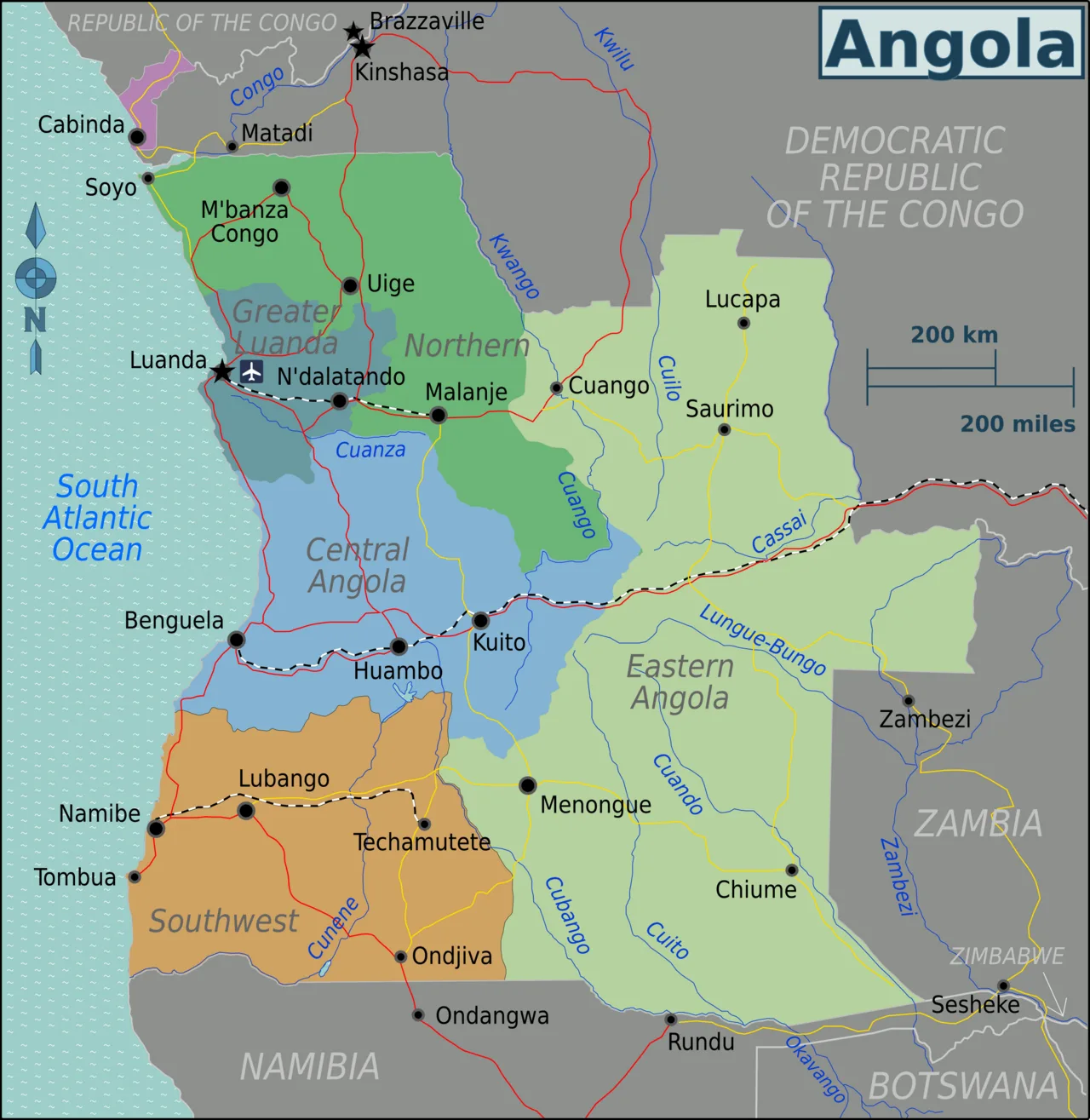
The Angolan Civil War was a 27-year war for control of Angola fought from 11 November 1975 to 4 April 2002, principally between the People's Movement for the Liberation of Angola (MPLA), which held the capital Luanda and became the recognised government, and the National Union for the Total Independence of Angola (UNITA), led by Jonas Savimbi — with a third movement, the National Front for the Liberation of Angola (FNLA), eliminated as a military factor in the war's first months (compiled record). It is widely considered a Cold War proxy conflict: the Soviet Union and Cuba backed the MPLA, the United States and apartheid South Africa backed UNITA, and the fighting intertwined with the South African Border War and, in the 1990s, with the Congo wars (compiled record). The compiled record divides the war into three periods of major fighting — 1975 to 1991, 1992 to 1994, and 1998 to 2002 — separated by fragile periods of peace. It ended in an MPLA victory: Savimbi was killed in February 2002, and UNITA demobilised and became a political party that August (compiled record).
Why did the war start?
The war started because decolonisation produced three armed movements with different peoples, different patrons and mutually incompatible leaderships — and no arbiter. Angola's three movements had their roots in the anti-colonial struggles of the 1950s: the MPLA was primarily urban, based in Luanda and among the Ambundu (Mbundu) people and the multiracial intelligentsia; the FNLA was based among the Bakongo of the north and tied to Mobutu Sese Seko's Zaire; UNITA, founded in 1966 by Jonas Savimbi after he broke with the FNLA, was based among the Ovimbundu of the central Bié Plateau — Angola's largest ethnic group, about a third of the population (compiled record). Britannica adds the electoral arithmetic inside that sociology: UNITA was militarily the weakest movement but had the greatest potential electoral support, given the Ovimbundu predominance, and therefore held out most strongly for elections (Britannica).
The transition designed to manage the rivalry collapsed before independence day. After Portugal's Carnation Revolution, the parties signed the Alvor Accords on 15 January 1975, but in July 1975 the MPLA violently forced the FNLA out of Luanda, UNITA withdrew to the south, and by August the MPLA held 11 of the 15 provincial capitals including Cabinda and Luanda (compiled record). Foreign intervention then internationalised the contest: South Africa intervened on 23 October 1975 in support of the FNLA and UNITA, Zaire deployed armoured cars, paratroopers and three infantry battalions for the FNLA, and within three weeks South African and UNITA forces had taken five provincial capitals (compiled record). Cuba answered with 18,000 soldiers under Operation Carlota (compiled record). The Portuguese army, tired of war, refused to impose peace and supervise elections, and Portugal withdrew in November 1975 without formally handing power to any movement, while nearly all the European settlers fled (Britannica). On 11 November Agostinho Neto declared the People's Republic of Angola in Luanda; UNITA declared a rival republic based in Huambo and the FNLA one based in Ambriz, and the two formed a coalition government at Huambo on 23 November (compiled record).
How did the war unfold?
The war unfolded in three acts: a conventional proxy war to 1991, a failed electoral settlement in 1991–94, and a resource-financed war of exhaustion to 2002. In the first act, Cuba's intervention proved decisive: Cuban-led forces routed the FNLA at the Battle of Quifangondo, forced its retreat toward Zaire, and halted the South African advance, concluding the conventional war by 12 February 1976; South Africa withdrew that February, while Cuba's force grew from 5,500 in December 1975 to 11,000 in February 1976 (compiled record). The United States, which had approved covert aid under Operation IA Feature in July 1975, was legislated out of the war by the Clark Amendment — passed by the Senate on 19 December 1975 and the House on 27 January 1976, signed on 9 February 1976 — and legislated back in only with its repeal on 11 July 1985, after which US aid ran at about $60 million a year to 1992 (compiled record). Through the late 1970s and 1980s the MPLA consolidated partial control without destroying UNITA: the FNLA withered in exile, but UNITA reorganised with South African and then American backing into an effective guerrilla force (Britannica; compiled record). The Soviet Union gave an additional $1 billion in aid in 1986 and Cuba held some 35,000 troops in the country, among them forces protecting Chevron's oil platforms (compiled record).
The act climaxed in the southeast. In 1987 a Soviet-planned MPLA offensive, Operation Saluting October, was crushed by the South African Defence Force's Operation Moduler — on 3 October 1987 alone over 600 MPLA troops were killed and 127 tanks, armoured cars and other vehicles destroyed or captured, against one SADF soldier killed (compiled record). UNITA and the SADF then attacked the MPLA base at Cuito Cuanavale from 13 January to 23 March 1988 under Operations Hooper and Packer, in fighting the compiled record calls the largest conventional battle in sub-Saharan Africa since the Second World War; both sides claimed victory (compiled record). What followed is not disputed: the Cuban government joined negotiations on 28 January 1988, a ceasefire was agreed on 8 August, and on 22 December 1988 Angola, Cuba and South Africa signed the New York Accords at UN headquarters, granting Namibia independence and ending direct foreign involvement (compiled record; Tripartite Accord record). South African forces had left Angola by 30 August 1988; Cuban troops began withdrawing on 10 January 1989 and completed the withdrawal a month early, on 25 May 1991 (Tripartite Accord record). Namibia gained independence in March 1990 (Tripartite Accord record; compiled record). An internal ceasefire agreed by dos Santos and Savimbi at Gbadolite on 22 June 1989 collapsed within two months amid rival interpretations of whether Savimbi had agreed to leave the country (compiled record).
The second act was electoral. With the Cold War ending, the MPLA abandoned the one-party state and Marxist-Leninism in 1990 (Britannica; compiled record), and on 31 May 1991 dos Santos and Savimbi signed the Bicesse Accords in Lisbon: a transition to multiparty democracy under the UN's UNAVEM II mission, demobilising 152,000 active fighters into a 50,000-strong unified armed force — a demobilisation UNITA largely did not carry out while the government did, leaving the government disadvantaged (compiled record; CRS). Angola voted on 29–30 September 1992, its first free elections, with turnout above 91 percent (1992 election record). Dos Santos took 49.57 percent of the presidential vote to Savimbi's 40.07 percent — short of the 50 percent needed to avoid a runoff — and the MPLA won 129 Assembly seats to UNITA's 70 (IPU; 1992 election record). Savimbi and eight opposition parties rejected the results as rigged; the process broke down on 31 October in Luanda, and in the killings known as the Halloween Massacre several thousand to tens of thousands of UNITA members or supporters were killed nationwide — the compiled narrative's figure is over ten thousand UNITA and FNLA voters (1992 election record; compiled record). UNITA resumed the war and by August 1993 controlled about 70 percent of the country (compiled record). The Lusaka Protocol — signed on 31 October 1994, with a ceasefire on 20 November — reaffirmed Bicesse, providing for UNITA's disarmament, demobilisation and participation in a government of national reconciliation (CRS; compiled record). A Government of Unity was installed in April 1997, but UNITA kept its army and its diamond revenues, the UN tightened sanctions in 1997 and 1998, and in December 1998 dos Santos rejected the protocol and the war resumed in full (compiled record).
The third act was decided by attrition and money. The government's Operation Restore, from September 1999, retook UNITA's central-highlands strongholds including Bailundo and Andulo; by December 1999 the chief of staff claimed 80 percent of UNITA's militant wing destroyed (compiled record). Government forces gained the Lunda diamond fields in September 2000, hurting Savimbi's ability to pay his troops (compiled record). On 22 February 2002 government troops killed Savimbi in Moxico province (UN Secretary-General's report; compiled record). The government halted all offensive operations on 13 March, commanders met at Cassamba on 15 March, and on 4 April 2002 they signed the Luena Memorandum of Understanding, providing for UNITA's demobilisation and integration into a unified military (UN Secretary-General's report; CRS). UNITA declared itself a political party and officially demobilised in August 2002 (compiled record).
How many people died?
No agreed total exists, because Angola never had a wartime count: the figures are retrospective estimates, and they measure different things. The compiled record's summary figure is that between 500,000 and 800,000 people had died by the MPLA's victory in 2002, with over one million internally displaced (compiled record). Its infobox states the displacement differently — 800,000 killed and 4 million displaced — and its aftermath section puts internal displacement at 4.28 million people, one-third of Angola's total population, with the UN estimating in 2003 that 80 percent of Angolans lacked access to basic medical care and 30 percent of children would die before the age of five (compiled record). The higher death figure also circulated at the war's end: humanitarian agencies cited in April 2002 reporting estimated one million killed and 4.2 million uprooted, a third of the population (contemporaneous reporting of the Luena ceasefire). This article therefore publishes the toll as a range — roughly 500,000 to one million dead — and attributes each bound to its source rather than splitting the difference.
The war's phases carry their own partial counts. The compiled record estimates that perhaps 120,000 people were killed in the first eighteen months after the 1992 election alone — nearly half the casualties of the previous sixteen years of war (compiled record). For the Halloween Massacre of late October–November 1992, the election record gives several thousand to tens of thousands of UNITA members or supporters killed nationwide in a few days; the compiled narrative states over ten thousand UNITA and FNLA voters (1992 election record; compiled record). Foreign losses are documented more narrowly but still as ranges: Cuban dead are put at between 2,016 and 5,000, South African dead at 2,365 to 2,500 including South African Border War deaths, and Soviet dead at 54 on the compiled record's tabulation, while the MPLA's own records show 14,269 dead with the final count unknown and UNITA's and the FNLA's losses simply unknown (compiled record). The killing also continued by other means after battles ended: militant forces had laid approximately 15 million landmines by 2002, and the displaced — 75 percent of all landmine victims, on the UN humanitarian office's estimate — fell victim to them disproportionately (compiled record). Human Rights Watch estimates the two sides employed more than 6,000 (UNITA) and 3,000 (government) child soldiers, some forcibly impressed (compiled record).
What were the economic effects?
The economic effects were a paradox the war itself created: Angola was rich enough to finance a 27-year war and was impoverished by financing it. The starting damage was institutional. The Portuguese who fled in 1975 accounted for the majority of the skilled workers in public administration, agriculture and industry, and once they left the national economy began to sink into depression (compiled record). The MPLA's transformation of the economy along communist lines was pursued, Britannica records, with disastrous results — with one major exception: the oil industry, managed by foreign companies, grew rapidly enough to enable Angola to stave off economic and military collapse (Britannica). Oil, much of it in the Cabinda exclave, was the government's war chest: by 1986 Cuban troops were protecting Chevron's platforms, and Savimbi publicly called Chevron's presence a target (compiled record).
UNITA's war chest was diamonds. By the end of 1992 UNITA controlled approximately two-thirds of the country, including valuable diamond mines used to pay for the continuing costs of the war (Britannica). The UN's Fowler Report documented the trade's plumbing — intermediaries supplying UNITA with Eastern European weapons against diamonds routed to De Beers' buying office in Antwerp — and De Beers openly acknowledged spending $500 million on legal and illegal Angolan diamonds in 1992 alone (compiled record). The United Nations estimated Angolans made between three and four billion dollars from the diamond trade between 1992 and 1998, of which UNITA made at least $3.72 billion — 93 percent of all diamond sales — despite international sanctions (compiled record). That revenue is the documented bridge between the war's two eras: it replaced the superpower subsidies — the Soviet Union's additional $1 billion of 1986, the United States' roughly $420 million to UNITA between 1985 and 1992 (compiled record) — after those subsidies ended. The physical bill was counted in the same decades: the compiled record puts damage inflicted on Angola between 1975 and 1989 at over $30 billion, and the UN spent $1.6 billion maintaining a peacekeeping force in 1994–98 alone (compiled record). The government also bought private force: Executive Outcomes, the South African private military company, trained up to 5,000 troops and 30 combat pilots for the MPLA in the 1990s, in what one US defence expert cited in the compiled record called the best fifty or sixty million dollars the Angolan government ever spent (compiled record).
How did it shape the world?
The war shaped the world first by settling southern Africa's map. The chain from Cuito Cuanavale to the New York Accords produced Namibia's independence in March 1990 — the last major act of African decolonisation — and removed South Africa's army from Angola and its administration from Namibia in the years immediately before apartheid itself ended (Tripartite Accord record; compiled record). Nelson Mandela's verdict, quoted in the 25th-anniversary literature, was that Cuito Cuanavale was "the turning point for the liberation of Africa from the scourge of apartheid" (Invent the Future). Angola's government then exported its war's logic: in 1997 it joined the coalition that overthrew Mobutu — its old patron of the FNLA and UNITA — in Zaire, and intervened in the Republic of Congo to remove a government that had let UNITA circumvent sanctions through Brazzaville (compiled record).
Second, the war set precedents in how wars are financed and policed. The Fowler Report of March 2000 — the UN Panel of Experts' investigation of sanctions violations against UNITA — named the governments, companies and intermediaries moving UNITA's diamonds, and is credited in the sanctions literature with establishing the link between the illicit diamond trade and conflict that led to Security Council Resolution 1295 and the Kimberley Process Certification Scheme for rough diamonds (compiled record; Fowler Report record). Angola was, in that sense, the case on which the modern "conflict diamonds" regime was built. Inside Angola, the settlement of 2002 shaped the state that followed: the MPLA, in power continuously since 1975, won the war outright rather than sharing power, UNITA survived as the parliamentary opposition its 70 seats of 1992 had prefigured, and the Cabinda separatism of FLEC — fighting over the exclave that produced much of the oil — continued beyond the civil war's end (compiled record).
What do historians debate?
Historians debate, first, whether Cuba was a proxy at all. Piero Gleijeses, professor at Johns Hopkins' School of Advanced International Studies and the first non-Cuban scholar admitted to the closed archives of Cuba's Revolutionary Armed Forces, argues across Conflicting Missions: Havana, Washington, and Africa, 1959–1976 (University of North Carolina Press, 2002) and its sequel Visions of Freedom: Havana, Washington, Pretoria, and the Struggle for Southern Africa, 1976–1991 (University of North Carolina Press, 2013) that Havana acted on its own initiative — humiliating the United States and defying the Soviet Union — and that Cuba's victory in Angola in 1988 forced Pretoria to set Namibia free and helped break apartheid (publisher's description of Visions of Freedom). Edward George's The Cuban Intervention in Angola, 1965–1991: From Che Guevara to Cuito Cuanavale (2005), written from interviews and Cuban, Angolan and South African archives, reaches a cooler verdict: it calls the Cuito outcome a "spurious 'victory'" and the 1975 intervention not a heroic gesture of solidarity but a last-ditch gamble to avert disaster (George, publisher's text). The disagreement is over agency and outcome, not over the scale of the commitment: Gleijeses's reviewers put Cuba's total contribution at some 380,000 military personnel rotated through Angola between the 1970s and 1991 (Gleijeses review coverage).
Second, they debate Cuito Cuanavale itself. Both sides claimed victory at the time (compiled record). Gleijeses holds that the town was a South African objective and that the failure to take it was a resounding defeat with the political consequences described above (Szabo). Janet Szabo's 2017 King's College London dissertation, built on declassified SADF archive documents, re-evaluates exactly that perception: whether there was a battle for Cuito Cuanavale at all, whether the settlement was an SADF objective, and whether a year of separate operations — Moduler, Hooper, Packer, Displace and Hilti/Prone, spread over hundreds of square kilometres — can accurately be conflated into a single "Battle of Cuito Cuanavale" (Szabo). The careful position distinguishes the two questions: what the fighting decided militarily remains contested on the documents; that the 1988 settlement followed it, and freed Namibia, is the documented sequence (Tripartite Accord record).
Third, they debate why the war lasted so long. The Cold War explanation covers 1975–91 well — superpower money, Cuban and South African armies, a US aid programme switched off and on by Congress (compiled record). It cannot cover 1992–2002, when the patrons were gone and the war was at its most lethal: roughly 120,000 dead in the eighteen months after the election, on the compiled record's estimate. The resource explanation fills that gap on documentary evidence — the UN's own panel traced UNITA's $3.72 billion in diamond sales, and the government's oil income never depended on controlling the interior (compiled record; Britannica). The two explanations are sequential rather than rival: Angola's war began as a struggle for a state that outsiders internationalised, and it persisted, once they left, as a war both sides could afford to keep fighting.